Emily M. DeArdo

author

Lent,knitting

Yarn Along No. 56: New project!

books, yarn along, knittingEmily DeArdoComment

It seems like a pattern--every time I do a new project, I have to start it three times. And the third time, it holds. 

Such was the case with my newest project, the Supermoon Kerchief. And let me tell you, ripping it all out twice was really, really irritating! But I think I have success! 


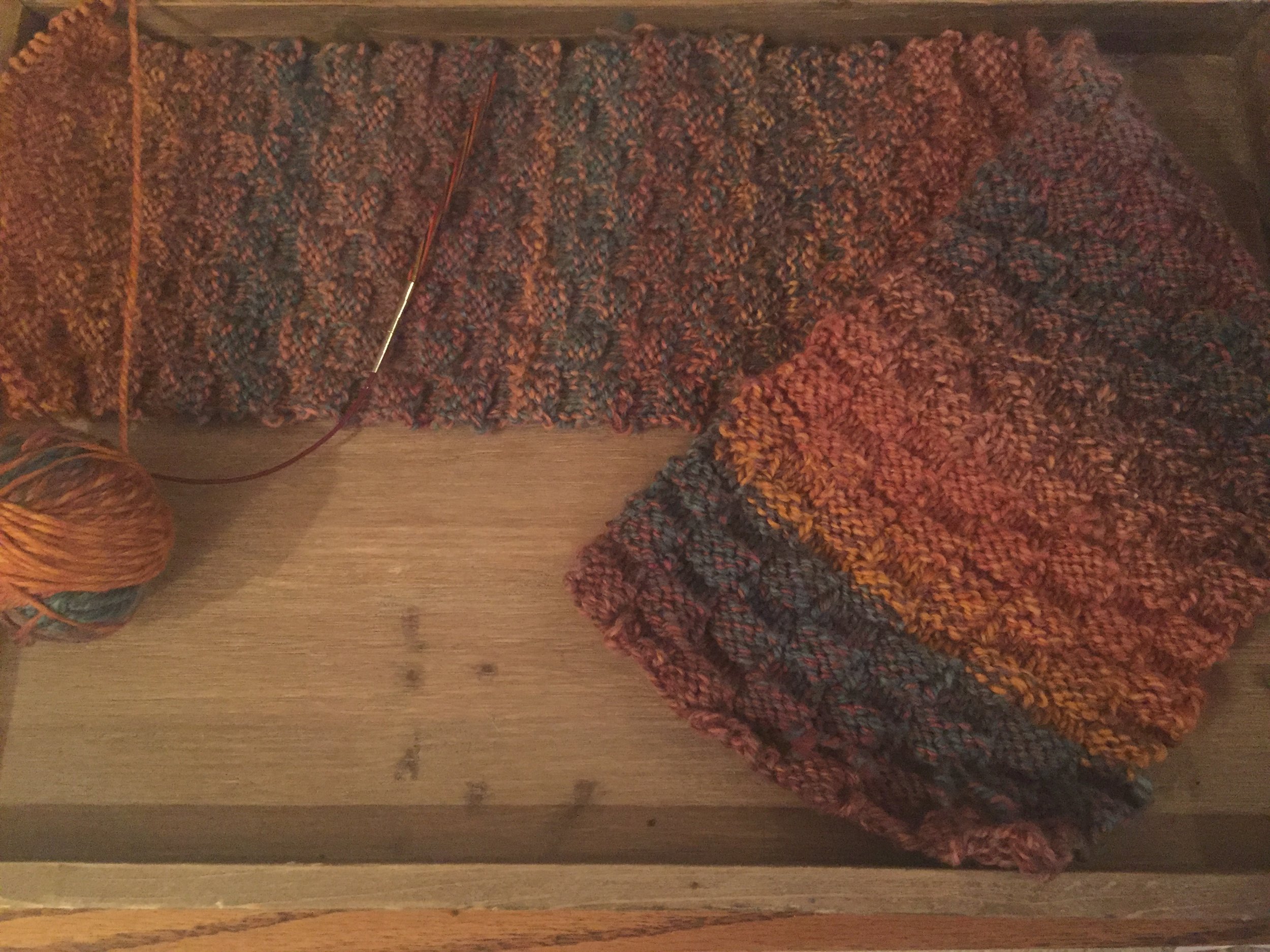
This project is knit with linen yarn,  and it's almost a lace pattern--the varying stitch pattern gives some really nice texture (which makes sense, since the book the pattern is from is called Texture.) This is the first project I'll have to block, so I'm also sort of nervous about that, but I'll worry about that later! 

I'm using Quince and Co. Sparrow yarn in Venice, and Knitpicks circular needles, size 4. Ravelry notes here

Since it's Passiontide, I'm trying to be more overtly religious in my reading. So these two are on the pile for this week: Anima Christi, and Death on a Friday Afternoon. 


Yarn Along 55: When Following the Pattern Goes Awry

books, knitting, yarn alongEmily DeArdo7 Comments

When you're knitting, usually, if you follow the pattern, you'll get something like the picture in the book. 

Unless the pattern is really, really off, as such was the case with this week's project. 

After I finished my scarf, I was just totally in love with knitting. I began to plan and plot for my next several projects, one of them being this envelope bag from the Chicks With Sticks Guide to Knitting

I followed the pattern precisely. I got the types of yarn indicated. I used the right size needles--which meant I had to get them, because I didn't have size 15s, but hey, I needed them for the next project too. 

And it turned out...oddly. 

It's supposed to be tiny. Like, glasses size case tiny. This is NOT tiny. It's like 13 inches! Now, I didn't felt it--because apparently you're only supposed to felt with 100% wool, and that's not what this wool was. (That wasn't specified in the instructions, either. Grrr.)  Ravelry notes here. 

However, even though it's enormous, I did like knitting this, and I liked whipstitching the edges of the bag, because one of my hangups had been "sewing and knitting? Whaaa?" Now I see how it works. 

I'm using the bag to hold my knitting notions: extra tapestry needles, my tape measure, needle gauge, stuff like that. I will sew a button on this guy at some point. And I do love the colors I chose. 

My work in progress is this guy: a basic washcloth. But different! 

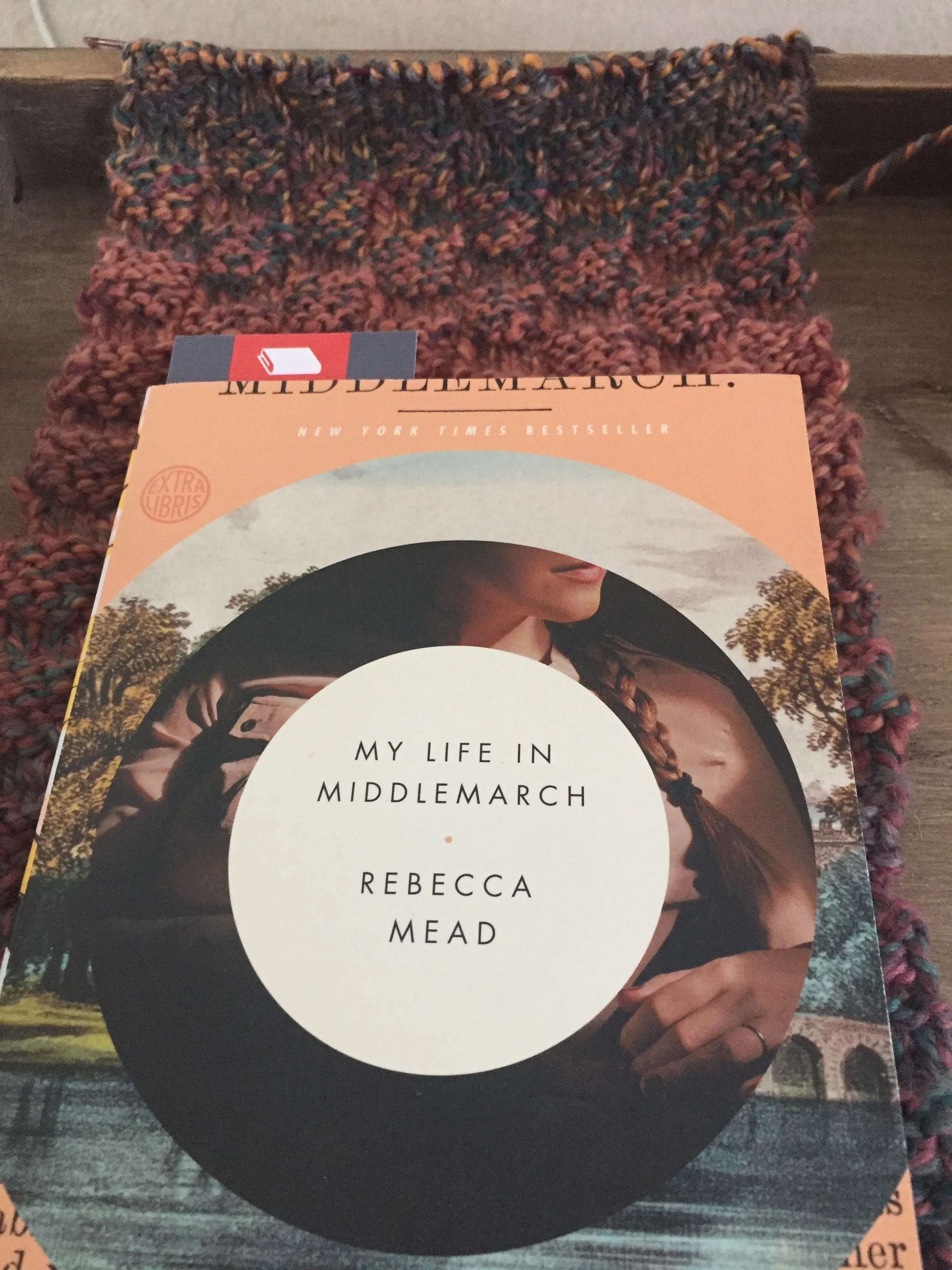
I know--books, not magazines--but I love the dark yarn against the pale cover!

I know--books, not magazines--but I love the dark yarn against the pale cover!


It's done with a cotton/linen yarn. The next "real" project in my queue is a linen kerchief, and knitting with linen yarn is really different. (I did a few rows of the kerchief pattern with the linen yarn--Quince Sparrow, Venice colorway.) So I decided, before I go to work on the "real" project, let's use this linen/cotton blend and make up a washcloth, to get a feel for linen, even in a blend. 

Linen tends to really slip off needles, I learned (quickly!). But the stitch definition is amazing. You can't really see here, but even in a blend, the linen makes a difference.  It's going to be great in the kerchief project, which is all about texture.  

(Colorway for washcloth is Planetarium, Knitpick's Cotlin.)

As for real books, I have Adam Bede and The Mill on the Floss to read next. 


Yarn Along No. 54: A completed project!

yarn along, knitting, booksEmily DeArdo2 Comments

This post contains affiliate links. 

Ta-da! It's finished! Yay!!!!!! I'm so proud of this project and I have to say I love how it all came together. I'm definitely going to do this project again, probably for a Christmas gift, and I already have the colorway picked out. (Same yarn as this project but more winter pastel-ish.) You can follow the progress on Ravelry and see my very few notes, if you're so inclined. 

As for books, I'm re-reading An Echo In the Bone, and I finished Jo's Boys over the weekend. Since I finished My Life In Middlemarch this week, I so want to read more Eliot novels, namely Adam Bede and The Mill on the Floss. But alas, I have to wait until Sunday to see if I can scope them out at a local bookstore. 

(Yes, on Sundays, you're allowed to take a day off from your Lenten penance. I will not go crazy, however. I will see if I can find one of these novels. :D )

Yarn Along No. 53: Ash Wednesday knits!

books, knitting, yarn alongEmily DeArdo3 Comments

Happy (?) Ash Wednesday! Did you get your ashes today? Or are you going to? 

(This post contains affiliate links)

I am at 60%!!! Yay!!!!! This weekend I put on season one of Outlander and just went to town, doing so many rows. I'm really in the groove right now with this guy and I'm loving all the color changes. 

Here's a slightly better view of the colors and a sense of the length--it's 30 inches right now. I'm excited because I see a beautiful blue colorway coming up and y'all know how I love blue!

The book is Jo's Boys, the last of the Little Women books. I'm also reading A Piece of the World and God or Nothing for various book clubs, as well as My Life In Middlemarch and Kim. Oh, and A Breath of Snow and Ashes. 

Whew! That's a lot of books. 

What are you reading this week? 

How to scramble eggs (Or: Food for Lent)

food, LentEmily DeArdoComment

There was a time in my life when I didn't know how to scramble eggs. It was a sad time. 

To scramble eggs, you need four things: 

* an appropriately sized frying pan

* eggs

* butter 

*a fork 

That's it. You don't need anything fancy, you don't need herbs and spices. You don't even need a knife.  (Well, you need a heat source. Oven. Fire. Hot plate. Whatever.) 

Scrambled eggs are a great go-to meal, especially during Lent, when we're supposed to be fasting and abstaining from meat on Fridays (and Ash Wednesday, which is tomorrow). Scrambled eggs can be deliciously decadent (I've seen recipes that serve them with caviar) or monastically simplistic. I'm going to give you three versions here, all of them Lent appropriate: one basic, one sweet, and one savory. 

You decided what one you want for your abstinence and fasting days. Or really, any day. I love to make scrambled eggs for lunch. They're filling and delicious and super-economical. Perfect for Lent, or any time you want something filling and healthy--and simple. 


Version 1: Monastic Simplicity

  • 2-3 eggs
  • 1 tbsp. unsalted butter (or salted, if you have it. I usually use unsalted.)
  • Salt
  • Pepper

Crack the eggs into a small bowl, and add a pinch of pepper and salt. Whisk together with a whisk or a fork until the yolks are beaten up. 

In a small skillet (8-9"), melt the butter over medium heat. When the butter is melted, pour in the eggs. Move the fork in a back and forth pattern through the eggs until the eggs are scrambled to your preference. Slide onto a plate and season to taste with salt and pepper. 

Version 2: Savory

(Based off a Rachael Ray recipe) 

  • 2-3 eggs

  • Tabasco sauce (if you want it)

  • salt

  • pepper

  • herb and garlic cheese, such as Boursin

  • 1 tbsp. butter

Combine eggs, tabasco, salt, pepper, and a few chunks of the Boursin into a mixing bowl. Whisk with a whisk or a fork. Melt the butter in the skillet and proceed as above. 

You could also use grated cheese in this: pepper jack, cheddar, colby, etc. 

Version 3: Sweet

(Based off a Giada de Laurentiis recipe) 

  • 2-3 eggs
  • 1 tbsp. of sugar
  • dried mint flakes--anywhere from 1/4 tsp. to a full tsp. (Or even more, if you love mint)
  • 1 tbsp. heavy cream
  • 1 tbsp. butter

Mix eggs, sugar, mint flakes, and heavy cream as above. Proceed with preparing the pan and scrambling eggs as above. These are really good when served with strawberries. 


(And if you missed it: Here's my post on fasting and abstaining during Lent.)

An acceptable time: Lent is almost here!

LentEmily DeArdoComment

YEs, friends, it's that time again! 

Lent!

Today is a Lenten extravaganza: links for you to read and ponder as Lent starts on Wednesday. Tomorrow--Lenten food. But today, reading material. 

I did a Lent series last year, and here are the parts: 


Fasting and Abstinence

Confession 

Prayer

Stations of the Cross

Almsgiving


And here are some other good Lent links: 

* The Biblical basis for Fasting (and Lent, in general)


*Practical Thoughts for Lent


Do you have Lenten plans? What are they? 


Yarn Along No. 52--and a blogging update

books, writing, yarn along, knittingEmily DeArdo4 Comments

(This post contains affiliate links.) 


I love the colors that I'm working in here, and the second skein is about to start--I've attached the end of the first one to it, so really, any stitch now I'll be working with new yarn. At this point, I've gotten used to the pattern and don't have to count or really even think too much about what I'm doing, other than to remember if it's row one, two, three, or four in a particular stitch pattern.  This doesn't mean that I can work on this while I'm watching TV--I have to be concentrating on this, but it's not nearly as tough as it was when I first started. 

The book I'm showing here is Voyager, Number Three in the Outlander series, which I love. This is the book that season 3 of the TV show will be based on, so I'm prepping for its September airing. Normally I re-read the series at least once a year. I'm also still reading My Life In Middlemarch which I talked about last week

(I'm generally reading 2-3 books at a time, so I pick one to show with my Yarn Along. :)  My knitting might not change much, but my books do!) 

As far as blogging updates: You've probably noticed that it's mostly yarn and books over here lately. Part of that is there's nothing I have a real BURNING desire to write about. :)  And part of that is, I think I need to ponder the overall theme and timbre of the blog in general--what sort of stuff do I want to write about, what do I need to write about, and what do you readers want me to write about? So I'm pondering all those things and hoping that y'all will send me suggestions or comments. (Wink, wink.)

I'm still working on the ebook--I have drafts of almost every chapter now, yay!--and I'm still working on getting the next book proposal written (same book, different proposal for a different agent). That's obviously taking a lot of writing energy, as well. 

So that's the writing update! 


Yarn Along No. 51

books, yarn along, knittingEmily DeArdoComment

(this post contains affiliate links) 

I'm about to start the second skein of yarn on my scarf!

So of course I had to add the new yarn ball to the photo.  I'm 36% finished with the scarf, so I would take that to mean I'll need another skein + some of the third one. The question will be what to do with the leftover third skein. I guess I could get more of this yarn and start another scarf! :-p 

Here is a better look at the color variations that were worked this week. Delicious colors!

The book is one I received from my aunt. She highly recommended it, and since I just finished Middlemarch like, two years ago, I can finally read this. I kept trying to start the book for abut 10 years, and finally just sat down and read it--and am glad I did. My advice to new readers? Stick with Dorothea. Really. Don't abandon her in her stupidity! It gets better!!!!


Yarn Along No. 50

books, yarn along, knittingEmily DeArdo8 Comments

this post contains affiliate links

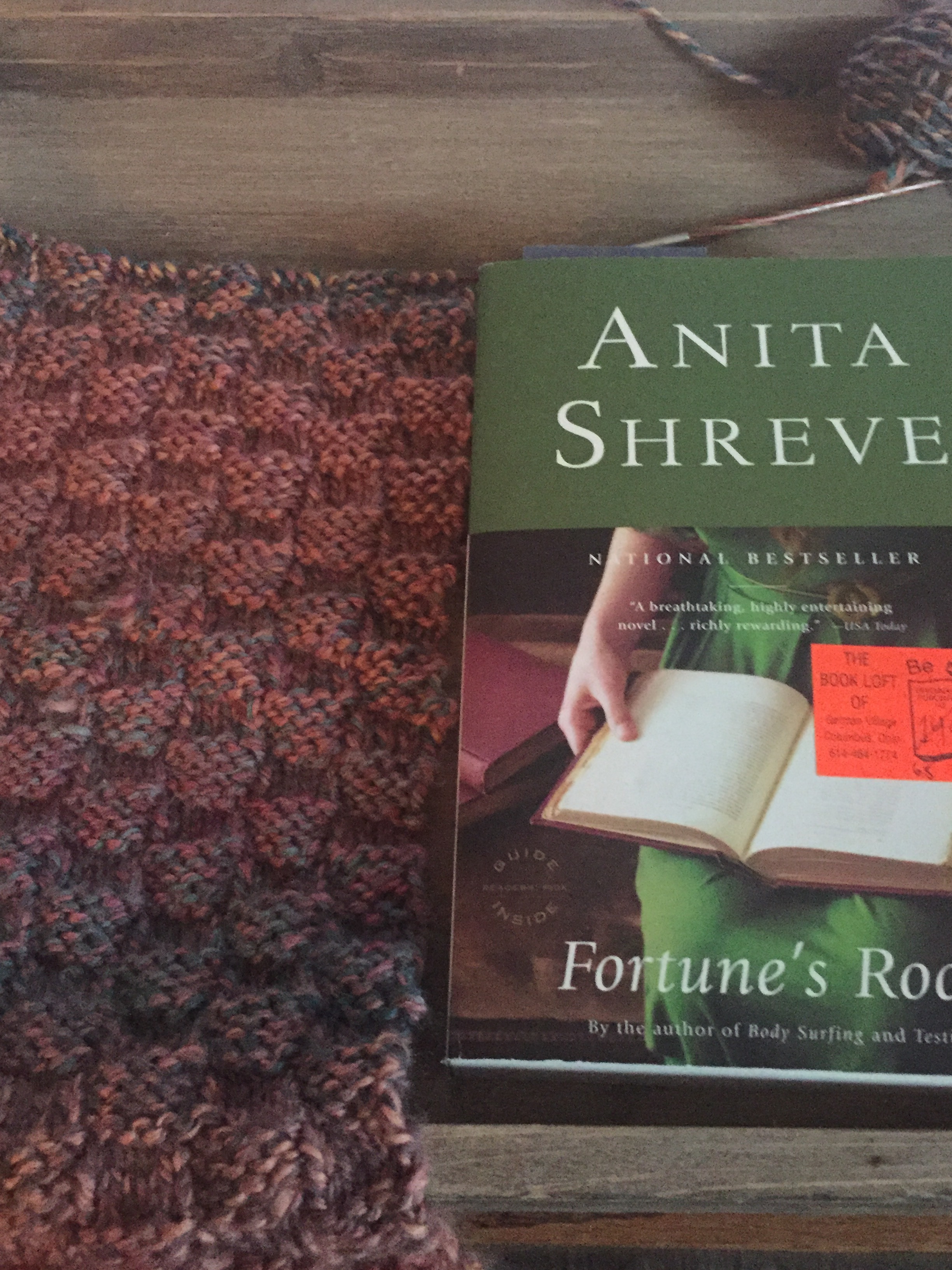
This week's book is  Fortune's Rocks by Anita Shreve. I picked it up awhile ago but I'm just now getting around to reading it. I love her other books that I've read, so I was happy to find this one half off at a local bookstore!

The scarf is growing really well, so I thought I'd share some detail shots today: 

I love how the blue is coming back into play!

I love how the blue is coming back into play!

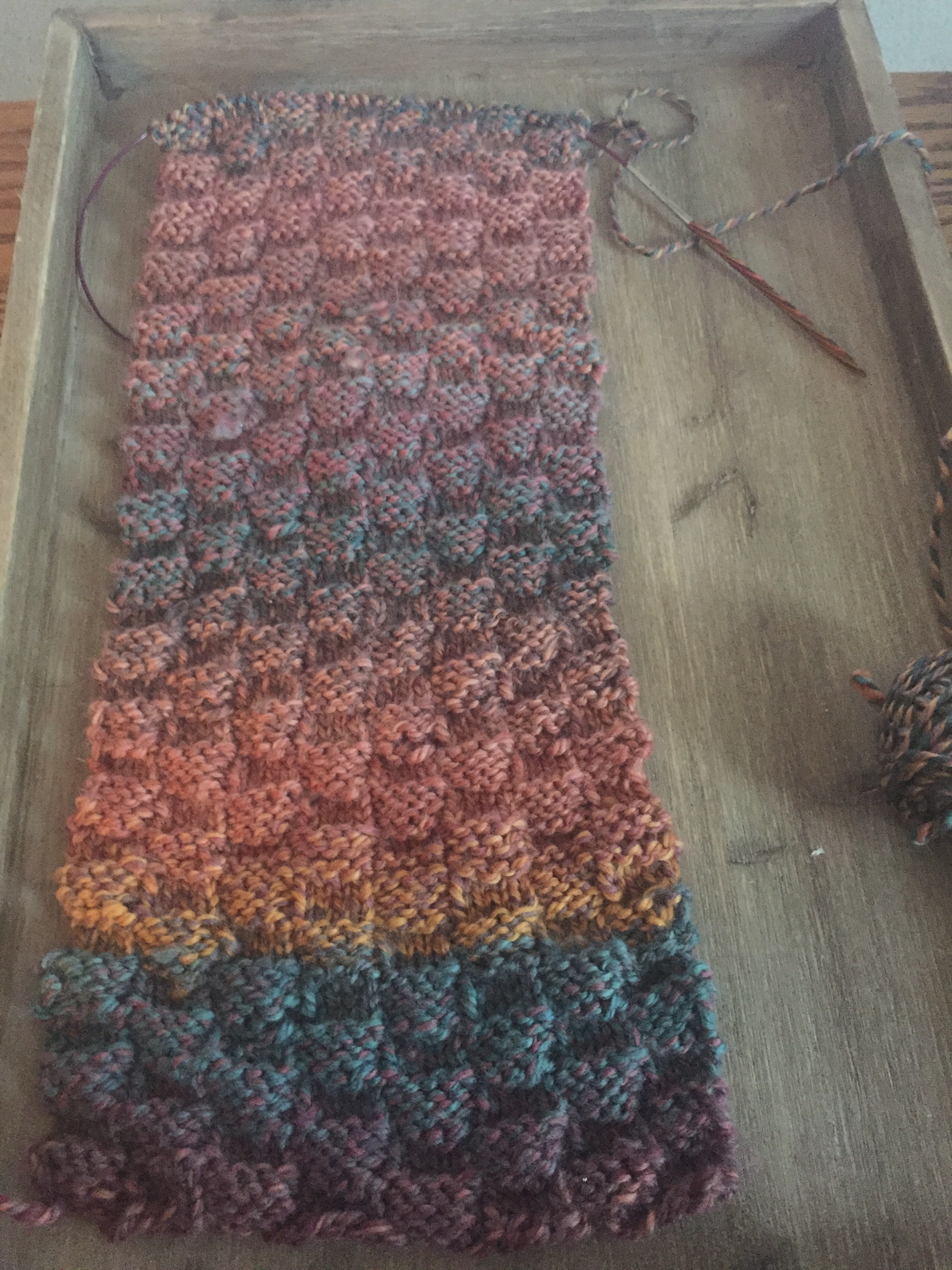
And here is a shot of the entire piece so far: 

Looking at this scarf like this, I just adore all these color shifts. I'm almost at the end of the first skein so this is the variation I've gotten thus far. Isn't it pretty? 

Yarn Along No. 48

books, knitting, yarn alongEmily DeArdo3 Comments

(this post contains affiliate links) 

The scarf continues!

I really love the color variations here, so that makes this a fun project to work on. Instead of just doing the same pattern in a solid yarn, which would be pretty, too, there's the extra fun of seeing the colors change as I work it up. 

Kim is a Christmas gift book and I'm working through it. It's been interesting, so far, but I was sidetracked by reading all about the President's wives--I zoomed through The Residence, First Womenand Upstairs at the White House this week, all of which were great and I highly recommend them. And now, back to Kim


2017 Goal Setting

writing, essays, goal setting, Tidying Up, knitting, health, current projectsEmily DeArdo1 Comment

The last week of the year usually brings a few things for me--time with family, lots of books, and goal setting for the new year!

Ever since I discovered Lara Casey's powersheets, I've adored goal setting--and I've actually been getting things done. Her shop is called "Cultivate what matters", and that's what the powersheets do. Without them, there's no way I'd have finished my manuscript, written book proposals, sent queries, or upgraded my website/social media presence. That's probably the biggest thing the powersheets have done for me, but I've made progress in other ways, too. 

(And, no, I don't get paid to say this--I just love powersheets!)

I got my 2017 set in November and spent a few days doing the prep work. This is one of the best parts of power sheets. It's where you really get down to the reasons why you want to do things--why do you want to save money, or take that trip, or get that thing? What's your real motivation? Are you afraid to do big things? What's defeated you in the past from reaching your goals? (Lara's current blog series dives into this stuff, too!) 

So after doing the prep work and figuring out my "big" goals for the year, I then break those goals down into monthly, weekly, and daily goals for each month. The idea is that everything you do here is intentionally helping you meet a goal that will help you do what matters in your life. 

With all that said, here are my goals for 2017: 

1. To deepen my prayer life through more regular attendance at daily Mass and more times of daily prayer/devotions. If I don't have a deep, solid relationship with God, nothing else matters. 

2. Pay off the rest of my debts and grow my savings account. One of the things I really like about post-transplant life is my ability to travel, and I want to do more of that--and traveling takes money! So by cutting back on buying things I don't need (I'm doing the contentment challenge in January to help with this), I'll be able to pay off debts and have money for fun things like traveling! Again, there has been progress in this area, but I need to be more consistent. 

3. Be physically, mentally, and emotionally healthy by instituting regular workouts, weekly meal planning, and keeping up with my journal (I've been letting my journal slide of late. I don't want to do that!). I have grown in this area this year, but it's erratic growth. I need to make it a much more permanent part of life.  

4. Get the book published, offer a ebook for sale, grow the blog, and write what matters. I want to write things that matter to the people who read them--things that help you, inspire you, make you laugh, whatever. I don't want to write click bait. I want to write things that improve the lives of my readers. (So tell me what you want to read, OK?) 

5. Fuel my creativity by continuing to learn Italian, working on new art and knitting projects, and, of course, reading. I love learning new things! 

6. Simplify my space: Less stuff, more beauty, more organization, and increased hospitality. I made big progress on this this year as well--cleaning out my closet, taking many books to the secondhand shop (along with CDs and DVDs). So I'm proud of the progress I've made here. But there's more to do!

So those are my six big goals for the year. Each month, these get broken into monthly, weekly, and daily things I need to tend (in powersheets parlance). Daily things are things I want to make a habit--like exercise, checking my checkbook against the online transactions, reading the Bible for 10 minutes every day, practicing Italian. Stuff like that. 

Weekly things are things that get done every week: Daily Mass at least once, making a meal plan, doing a basic clean of the house, putting a certain amount of cash into my emergency stash here at home. 

Monthly tending are bigger things that I can do throughout the month. Some examples from my January tending list are editing my Nano 2016 novel, going to confession, completing a 30 day exercise plan.  

Some things are broken into monthly and weekly categories. The contentment challenge is broken into three months, with a weekly topic in a corresponding book. So there's a monthly "task", but also something to read each week. So the weekly devotion is written in my weekly tending list, so I don't forget to do that. 

I also write the daily tasks into my planner. That also helps keep me on track, because if my powersheets aren't easily available (though I always keep them on my counter, so I can find them quickly!), I can see at a glance what I'm doing that day. It's also great for things like the weekly cleaning--I can dust on Monday, vacuum Tuesday, etc. 

I find this is a better system than making resolutions. Resolutions are OK, but they usually don't have a plan or a why attached to them. "Lose 20 pounds" is a nice resolution--but how to do it? By going through the powersheets, I have an idea of how to do the things I want to do, how to achieve my goals, and how to be accountable to myself. I only have so much time here and I want to use it to the best of my ability!

Do you have goals for 2017? What are they? 


Yarn Along No. 45

books, health, yarn along, knittingEmily DeArdoComment

So, here we are, back to the Wednesday Yarn Along!

I'm on the second book of the Mitford series, and I'm really liking them. They remind me of Alexander McCall Smith's books--everyday happenings, people living lives in their small towns, but you can't stop reading about them and immersing yourself in their world. Mitford is the American version of the Gabarone or Edinburgh of McCall Smith's stories. 

IMG_3057.JPG


 (And yes....using up that washcloth yarn!) 

Yarn Along No. 43 (and a little bit about Mystery)

books, yarn along, knittingEmily DeArdoComment

The scarf progresses! I'm getting so much better at purling. I've found that these are really great projects for me to get my bearings with new things, even though I know all of you are tired of seeing scarves and washcloths. I promise I will eventually give you something more challenging. Promise! 

As is my wont, I'm re-reading Outlander. Again. I usually do this at least once a year. At the moment I'm in the middle of book 7, An Echo In The Bone. As I was re-reading, I came across this passage, which I liked and thought I'd share: 

"I talked to Mama a little bit about it," Bree said after a moment's thought. "She laughed."
"Did she?" Roger said dryly, and got the breath of a laugh from Bree in answer. 
"Not like she thought it was funny," She assured him. "I'd asked her if she thought it was possible for a traveler to change things, change the future and she told me it was, obviously--because she changed the future every time she kept someone from dying who would've died if she hadn't been there. Some of them went on to have children they wouldn't have had, and who knew what those children would do, that they wouldn't have done if they hadn't...and that was when she laughed and said it was a good thing Catholics believed in Mystery and didn't insist on trying to figure out exactly how God worked, like Protestants do." 

--Diana Gabaldon, A Echo in the Bone

The reason I like this is because it's true. In general, Catholics are really comfy with Mystery. When I taught the kids about the Eucharist last week, they just went with it. Now, sure, there are the Eucharistic miracles, which show the validity of Transubstantiation (this one, from Italy, is my favorite), but there generally comes a point where we have to just accept mystery. We teach the kids this early on. We'll never fully understand the Trinity, or God, or really, anything else, probably--just like Bree and Roger can't ever understand why they're time travelers. 

Seven Quick Takes No. 104

7 Quick Takes, food, LentEmily DeArdoComment

I. 

Well, Winter has finally shown up here in Ohio. It's going to be three for a low this weekend. Brrrrr. Glad I have lots of warm socks and boots and a heavy coat that's good for clearing off the car. 

II. 

I'm learning Italian! I'm using the Duolingo app and I have to say it's really fun, although there's some weird Italian grammar things that do not exist in French or English. For example, the word "dinner" (cena) can mean the noun, dinner, or  "eating dinner." So if you want to say I'm having dinner, It's "Io cena." IT IS WEIRD. In French, it would be Je mange diner. You need a verb! Not in Italian! 

Also, their possessives are sort of tricky. I'm working on it. But learning Italian is something I've been wanting to do for a long time, so I'm glad I'm finally getting on it. 

III. 

Lent has begun, but you can still join Restore! It's not too late. 

IV. 

I'm taking my first Barre3 class next week. I will hopefully survive. ;-) Cristina loves them, and I've taken similar classes before, so I think I'll survive.....It's only an hour! One can do anything for an hour! (Right?)

V. 

One of the great things about winter is that I get to experiment with my cooking. When it's summer and gorgeous I don't want to be working with a hot oven. But tonight is perfect for something like Tuscan marinated chicken and couscous with feta and lemon. It's warm and filling and really easy! 

VI. 

Fasting is something I didn't have to do for the first 23 years of my life. And now that I have to, it's HARD. Man, I was GRUMPTASTIC Wednesday night, and I also inhaled my dinner like there was no tomorrow. 

VII. 

Outlander season 2 premieres on my birthday! (April 9) Happy birthday to me! I can't wait for Season 2 with my favorite time travelers. 


Lent 2016: My plan

LentEmily DeArdoComment

Happy Ash Wednesday! 

(Can we say happy Ash Wednesday?)

I've never minded walking around with ashes on my forehead, and no one's ever commented on it, except my boss's boss one year. He walked into our office around lunch and looked at the Catholics assembled, thought for a second, and said, "I didn't know you guys were Catholic." 

Ashes. A way of marking us out. :) 

So, we've talked a lot about Lent lately, and here's my plan: 

  • I'm going to try to follow the Nuns of Summit, NJ horarium as best I can. No, I probably won't be getting up before 6 AM. But I said try. :) 
  • No book buying. None. Nada. Zilch. (Except for the Women's Conference. I am making one exception, because it can be hard to find good Catholic books round these parts!)
  • My Lenten reading is A Time for Renewal, by Mother Mary Francis, PCC; Death on a Friday Afternoon, by Fr. Richard John Neuhaus, and On the Passion of the Christ by Thomas a Kempis. I'll also be sure to watch Jesus of Nazareth and The Passion a few times. (Both of them are great, if you haven't seen them.) 
  •  

Lenten Practices 6: The Liturgy of the Hours

LentEmily DeArdo1 Comment

The Liturgy of the Hours (AKA the Breviary, AKA the Divine Office) is, after the Mass, the most important thing for priests and vowed religious to pray. Cloistered orders usually pray all seven offices. Active orders pray, at a minimum, morning, evening, and night prayer. It is a way of sanctifying all the hours of the day, to pray  without ceasing.

And lay people do it too!

FEBRUARY 27, 2014 BY EMILY

Lenten Practices 6: The Liturgy of the Hours


The Liturgy of the Hours (AKA the Breviary, AKA the Divine Office) is, after the Mass, the most important thing for priests and vowed religious to pray. Cloistered orders usually pray all seven offices. Active orders pray, at a minimum, morning, evening, and night prayer. It is a way of sanctifying all the hours of the day, to pray  without ceasing.

And lay people do it too!

I wrote about this earlier: 

If you like structure in your prayer life, try saying the Liturgy of the Hours. A great site for this is divineoffice.org, where the prayers for the different hours are listed, and all you have to do is pray them! I have the four-volume set of the office, which I prefer, but I also love this website because it’s great on days when I’ve forgotten my breviary at home. (hey, it happens) The office is the daily prayer of the church, which priests are required to say. Monks and nuns chant these prayers as well, around the clock. Sisters and lay people don’t have to say as many “offices” of the Liturgy of the Hours. Usually I try to pray lauds (Morning Prayer), the Office of Reading, Vespers (Evening Prayer) , and Compline (Night Prayer). Morning and Evening prayer are called the “hinges” of the hours, since they sanctify both ends of the day–beginning and end.

But now it’s time to really talk about it. :) Get excited.

As a Lay Dominican, I’m required to say morning and evening prayer, the “hinge” offices as I call them, above. This isn’t binding under pain of sin–if I can’t, or forget, it’s OK. I usually don’t forget, but with my medical issues, there are times when I may have to miss an office, because I’m indisposed in some way/shape/form. That’s OK.

The offices (except for compline, which is the shortest office) are made up of: an opening hymn, three psalms or canticles (the canticles can be from the Old or New Testament), a short reading, a responsory, another canticle (morning prayer has the Canticle of Zachariah, from Luke; evening prayer is Mary’s Magnificat), petitions, the Our Father, and a closing prayer. The breviary has this all written out for you, so you just follow along when you’re praying it.

Now, it can get complicated. There are feasts and memorials that have separate things. For example, when it’s the Octave of Christmas, we say the Christmas office for eight days. For Feasts, there are usually special readings and psalms that are said. There are lots of “commons”: common of virgins, common of martyrs, common of apostles, common of pastors, etc. It sounds complicated, but once you get used it it, it’s not–and if you’re following at a site like  Divine Office, it’s all laid out for you anyway. For the most part, though, when you’re just starting, you can focus on the regular psalter.

The breviary has a four week cycle of psalms and readings, so every four weeks, you’re back to Week 1 in the book. I’ve found that saying the office, far from being boring, is always speaking to me afresh; I’ve read some sections three of four times by now as I’ve gone through the Liturgical Year, and sometimes it’s only on my latest reading of something that I go aha! It’s constantly speaking to me, and I know others who say the office regularly feel the same way.

If you want to start gently, find a website, or use Magnificat, which gives you a sample morning and evening prayer, as well as the Mass readings for every day. I love mine. If you’ve been saying it for awhile and you’d like the big physical books, you have options. There is the four-volume set, and the one volume Christian Prayer. I use the 4 volume set, which is broken down as:

  1. Advent and Christmas
  2. Lent and Easter
  3. Ordinary Time I
  4. Ordinary Time II

Christian Prayer has all these things together, and as such is usually a bigger book. These can be ordered online or found at any good Catholic bookstore. I find the books excellent because I can write in them (yes, I write in my books) and mark them with post-its for the more complicated offices. I also recommend you get the covers to go with them, otherwise your books will fall apart a lot earlier  (at least if you’re like me and bring them everywhere with you).

Lenten Practices 5: Almsgiving

LentEmily DeArdo2 Comments

OK, the third pillar of Lent (the other two are prayer and fasting/abstinence): Almsgiving.

I don’t know about you, but when I hear this word I think of Robin Hood in the Disney movie, disguised as a beggar in smoked glasses and croaking, “alms for the poor!”

This is not, really, what I should be thinking. :)

Anyway: Almsgiving. Alms is defined as: charity, or something (as money or food) given freely to relieve the poor. Some churches have poor boxes in the back for this purpose (mine does). Other have special collections for the poor throughout the year.

But during Lent, we should definitely be thinking about the poor, and how to relieve their poverty. So some increase in charitable giving is to be considered. There are lots of ways to do this: donate to a food pantry, work in a soup kitchen, pick something from a charity’s gift catalog (like World vision or other such), sponsor a child who lives in a poor nation, participate in Operation Rice Bowl, or donate to your diocese’s ministries for the poor. There are so many ways you can participate in almsgiving.

To be “poor” in the United States often means things like these statistics (from 2010):

  • 80 percent of poor households have air conditioning. In 1970, only 36 percent of the entire U.S. population enjoyed air conditioning.
  • 92 percent of poor households have a microwave.
  • Nearly three-fourths have a car or truck, and 31 percent have two or more cars or trucks.
  • Nearly two-thirds have cable or satellite TV.
  • Two-thirds have at least one DVD player, and 70 percent have a VCR.
  • Half have a personal computer, and one in seven have two or more computers.
  • More than half of poor families with children have a video game system, such as an Xbox or PlayStation.
  • 43 percent have Internet access.
  • One-third have a wide-screen plasma or LCD TV.
  • One-fourth have a digital video recorder system, such as a TiVo.

But to be poor in other countries means destitute–you’re living in hovels. You have no food or clean water. Your children are dying from malnourishment, or malaria, because of a lack of basic necessities. When we say dire poverty, this is what we mean. And yes, you can find this in pockets of America, as well. But I think during Lent it’s important to consider those who live in countries where the government cannot help them–there is no safety net. 

At the beginning of this series, I posted a list of 10 countries with the highest population of hungry people. It’s shocking to think that in Burundi, almost sixty-eight percent of the population is hungry. Think about that for a minute. Where I am right now, I am less than 50 feet away from a cafeteria that serves salads, sandwiches, burgers, coffee, cookies, artisan ice cream, and a variety of beverages. There are three vending machines down the hall. There are at least 10 places to eat within walking distance. My office has a water cooler of fresh, clean water for anyone who wants it. According to World Vision, “more than 1,600 children under age 5 die every day from diarrhea caused by unsafe water — that’s more than AIDS and malaria combined. Clean water, basic sanitation, and hygiene education are some of the most effective ways to prevent child disease and death.” 

We might not think we can make a difference with our few dollars that we can donate. But we can. A $20 (that’s a ticket to the movies and snacks, or a dinner out, or–for me–a hardback book, or a DVD/Blu-ray) donation to a clean water fund can save lives.

Like I said above, there are so many worthy places out there to give your money–this Lent, think about it. Think about the incredibly poverty that exists in our world, and do what we can to help alleviate it.

We can’t do everything, but as Mother Teresa said: “if you do something, and I do something, then together, we will do something beautiful for God.”

Lenten Practices 4: Stations of the Cross

LentEmily DeArdoComment

Anyone who’s been in any Catholic church notices them–the Stations of the Cross. Sometimes done in plaster molding, sometimes in steel and wood, sometimes on plaques, sometimes in bas-relief–they are always there, in every church, a gift of St. Francis to the Church.

The Stations of the Cross are always there, but seem to gain popularity during Lent, with many parishes offering communal services to pray the stations. As a child, we “did” the stations of the cross every Friday during Lent with our class at the parochial school I attended, every year.

The Stations recount Jesus’ journey to His crucifixion, from His condemnation by Pilate (the first station) to the burial in the tomb (the fourteenth, and last, station). While the number of stations varied over the years, St. Francis codified the stations, in a sense, and gave us the fourteen stations we see today.  The object of the stations is to travel, spiritually, to Jerusalem, and thus walk with Jesus on Good Friday, often with a spirit of penance and reparation for our sins.

The stations are:

  1. Jesus is Condemned to Death
  2. Jesus Takes Up His Cross
  3. Jesus Falls the First Time
  4. Jesus Meets His Mother
  5. Simon of Cyrene Helps Jesus Carry His Cross
  6. Veronica Wipes the Face of Jesus
  7. Jesus Falls the Second Time
  8. Jesus Meets the Women of Jerusalem
  9. Jesus Falls the Third Time
  10. Jesus Is Stripped of His Garments
  11. Jesus Is Nailed to the Cross (sometimes called the Crucifixion)
  12. Jesus Dies on the Cross
  13. Jesus Is Taken Down from the Cross
  14. Jesus Is Laid in the Tomb

Often in communal services, the hymn Stabat Mater (“At the cross her station keeping”) is sung. On Good Friday, the pope recites the Stations of the Cross at the Roman Colosseum, complete with prayers and meditations.  An excellent set for meditation are these, written by (then) Cardinal Joseph Ratzinger, before Bl. John Paul II died in 2005; the pope was too ill to complete his normal Good Friday practices, so the Cardinal took his place, writing his own series of prayers and reflections.

The stations are a superb Lenten practice, since the graces we receive from doing them in a spirit of prayerful recollection and penance are so immense. It is good for us to ponder these things, to realize why Jesus died, to see the supreme mercy of God–the extreme depth of God’s love for us. We all see the signs that say John 3:16: “For God so loved the world that He gave His only Son, that whoever believes in Him shall not perish, but have everlasting life.” By mediating on the stations of the cross, we can truly see that love–love that was so deep it sustained Jesus through His horrible torture and death.

(As a side note: The 2004 film The Passion of the Christ shows all the stations, in some depth. For older children and adults, I often recommend watching this film, because I haven’t found a better example in media of Jesus’ passion and death, and what it truly was. It’s easy to whitewash what happened to Jesus; even the Gospels don’t give us explicit accounts, probably because their audiences knew all too well the horror of crucifixion. But we need to see it, I think, to really get it, and to see how deep and how great that love was. )

So, check and see if your church has a communal stations service on Fridays during Lent, or just go to your church sometime and walk the stations. If you can’t get to a church, you can also meditate on them at home by using a prayer book or an online guide, like the one I posted above. The important thing is that, at some point during Lent, you really focus on what the season is about, and what happened on Good Friday.)

Lenten Practices 3: Prayer

LentEmily DeArdoComment

Lent is a great time to renew/revamp/reassess our prayer lives, and establish one, if you don’t already have one.

Prayer, as I explain to my first graders, is just talking to God. That’s it. It’s not some big mysterious thing that takes a lot of time. It’s just talking to someone who loves you.

I know a lot of Catholics trot out the “well I go to Mass every week.” At the Catholic Women's Conference I went to two years ago, one of the speakers (Rebecca Dussault) made a good point. She is a former Olympic cross country skier, and compared prayer to talking with her coach and training. If she only met with her coach one hour a week, she wouldn’t get to know her coach, the coach wouldn’t get to know her, and her training wouldn’t be that great. Thus, how can we possibly expect to love God with all our heart, soul, mind, and strength if we don’t talk to Him more than an hour a week?

There are so many different prayer traditions we have as Catholics; it is a rich tradition! As a Domincan, I’m partial to the rosary, of course. One set of mysteries takes me about 15 minutes to say. 15 minutes to say the Rosary is 1% of your day.  If you can’t say five decades, say one, one the way to work, or as you clean the kitchen, or take a shower. Starting slowly is better than not starting at all.

There are many good Catholic prayer books available at any Catholic bookstore or Amazon. But you can also use your own words. Tell God what you need; tell Him what you’re thankful for; tell Him about people you love. The four main types of prayer are: intercessory (praying for someone else), praise, thanksgiving, and petition (asking Him to help you). Any combination of these is great.

If you like structure in your prayer life, try saying the Litrugy of the Hours. A great site for this isdivineoffice.org, where the prayers for the different hours are listed, and all you have to do is pray them! I have the four-volume set of the office, which I prefer, but I also love this website because it’s great on days when I’ve forgotten my breviary at home. (hey, it happens) The office is the daily prayer of the church, which priests are required to say. Monks and nuns chant these prayers as well, around the clock. Sisters and lay people don’t have to say as many “offices” of the Liturgy of the Hours. Usually I try to pray lauds (Morning Prayer), the Office of Reading, Vespers (Evening Prayer) , and Compline (Night Prayer). Morning and Evening prayer are called the “hinges” of the hours, since they sanctify both ends of the day–beginning and end. (I’ll be talking more about this in a separate post, since it’s a big part of my life as a Lay Dominican.)

A great book for beginners is  Prayer Primer, by Fr. Thomas Dubay (or even not beginners–people who just want to read and learn more about prayer). This is followed by Deep Conversion/Deep Prayer. (If you want something that boosts your exiting prayer life, the latter book is a great way to start)

During Lent, you may want to pray the Seven Penitential Psalms.  These are psalms that particularly express the idea of penitence and are particularly a propos during Lent.

Prayer is our intimate time of conversation with God. Sometimes you may wish to try contemplative prayer, or a Holy Hour before the Blessed Sacrament. Sometimes I’ve kept a prayer journal where I write down specific intentions, or insights I’ve gained in prayer.

Whatever you’ve been doing, this Lent, try to add more. By giving things up, like facebook (which I’m doing), there is more time for prayer and spiritual reading. Let’s use those pockets of time to talk to God and deepen our relationship with Him.

Lenten Practice 2: Confession

LentEmily DeArdoComment

Ah, confession.


I never really liked it. As a kid, it freaked me out. And as I grew up, I went maybe three times a year.

Now I try to go much more often, once a month being my goal, but it works out to about once every six weeks. Working on it peeps. :)

Anyway–we’re gonna make this really short today. Go to confession at least once before the Triduum. Do a good examination of conscience (Scott Hahn’s book Lord Have Mercy has a great one in the back). Brush up on the Act of Contrition. (My church has them in the confessional, on the wall, but some churches don’t.) If you’ve committed mortal sins, remember they need to be confessed in kind and number (as in, what you did and how many times you did it). Do your penance promptly.